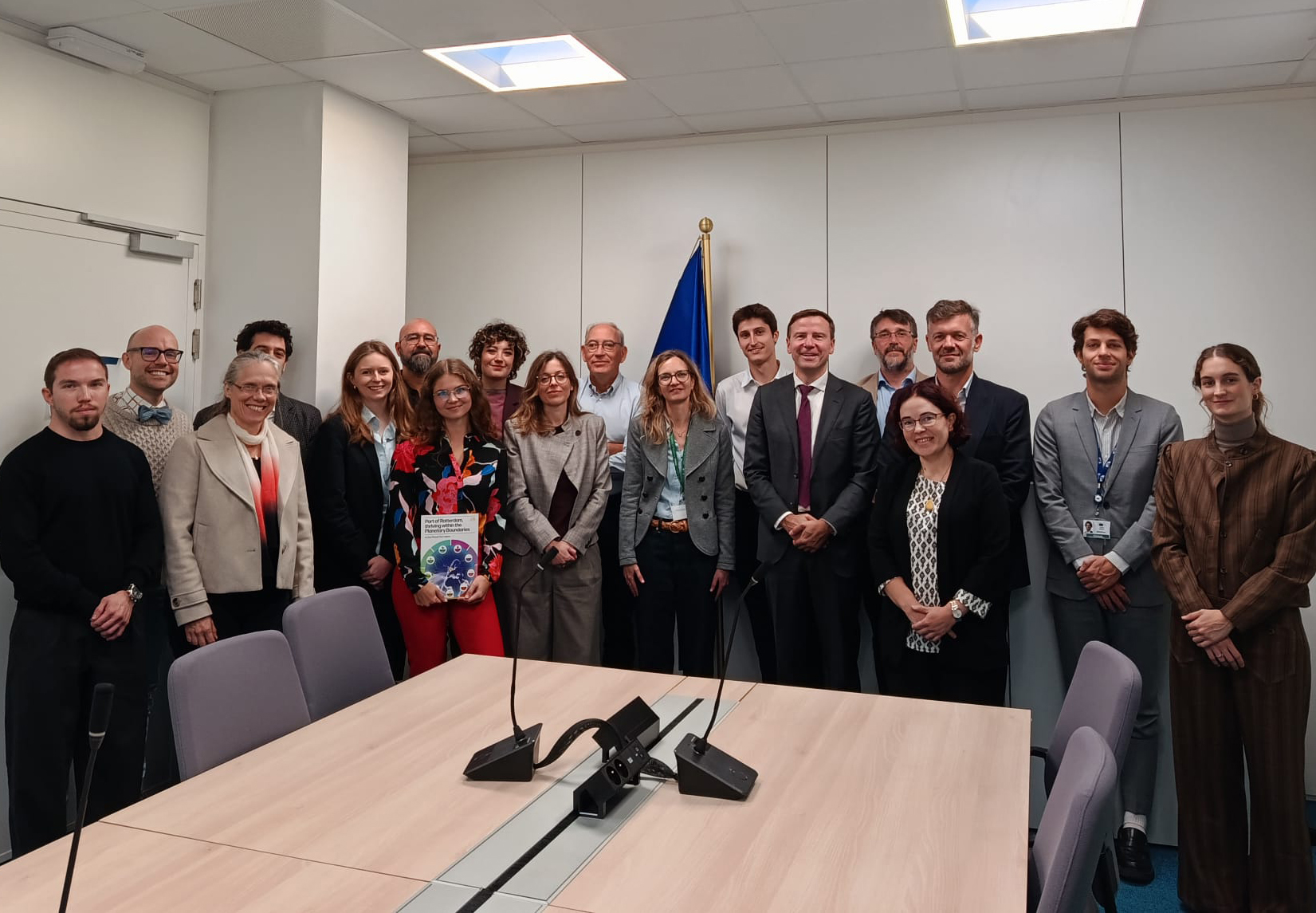
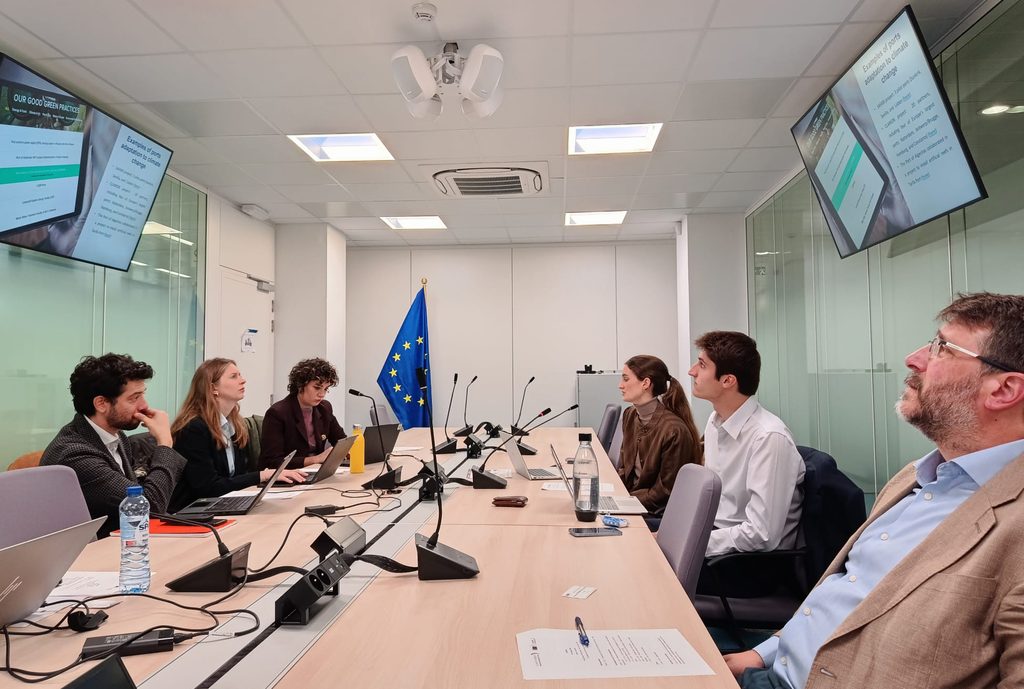
How can Europe’s Atlantic ports prepare for a changing climate? Around 20 participants met in Brussels on 19 October to discuss this question. They came from the European Commission (DG MARE, DG MOVE and CINEA), Atlantic port authorities and academia. The meeting was organised by Pillar I of the Atlantic Action Plan, Ports as Gateways and Hubs for the Blue Economy, and included representatives of the ports of Vigo, Lisbon and HAROPA (Le Havre-Rouen-Paris) and of the European Sea Ports Organisation (ESPO). Maëlle Salzinger (One Planet Port, PortCityFutures) presented together with Carola Hein (PortCityFutures, TU Delft) and Tanner Tuttle (One Planet Port).
The Atlantic Action Plan (AAP) puts into practice the EU’s Atlantic Maritime Strategy (2011). Marta Pascual (Spanish National Hub of the AAP) presented the current version, the Atlantic Action Plan 2.0 from 2020, which aims to unlock the potential of the sustainable blue economy in the Atlantic area while preserving marine ecosystems and contributing to climate adaptation and mitigation. The plan is a partnership between the four Atlantic member states, France, Ireland, Portugal and Spain.
The need for adaptation is pressing. EU ports handle 74% of the EU’s external trade. Meanwhile, 95% of ports are exposed to multiple natural hazards, and 70% already face operational challenges because of climate change, up from 41% in 2018. Pillar I has developed a methodological guide to climate adaptation for small and medium-sized ports, which was presented by Gerardo Gonzalez (Port Authority of Vigo). The guide helps ports assess which of their infrastructure is at risk and which tools they are missing.
One Planet Port and PortCityFutures broadened the picture: ports cannot adapt in isolation. Ports are part of both the problem and the solution to climate change and ecological breakdown, and their actions affect entire cities and regions. Scientists warn that if we cross ecological tipping points (for example, the loss of coral reefs), our environment risks becoming irreversibly unstable and unsafe, leaving humanity to survive rather than adapt.
One Planet Port’s Planetary Boundaries Compass reorients decision makers in port cities away from partial or false solutions, towards those that reverse the breach of the planetary boundaries while building long-term societal resilience. The Compass shows the risk of focusing on a single boundary alone, which can shift harm onto others, for example from climate to nitrogen and water. Blue ammonia, carbon capture and storage (CCS) and LNG are examples of such false solutions, and they also risk fossil fuel lock-in.
The Compass also warns against relying on efficiency alone: shipping emissions have grown 9.6% despite significant efficiency gains (Seas at Risk, 2023). Instead, One Planet Port recommends that policymakers use the most impactful levers first: corporate demand reduction, wind-assisted ships, electrification of ports and shipping, and restoring carbon sinks such as wetlands, tidal flats and salt marshes. Corporate demand reduction is a powerful lever to reduce energy needs, lowering the need to expand electricity grids, extract minerals for batteries and produce alternative fuels. This lever prompts us to reevaluate how energy is best used: for activities that benefit people, health and durable jobs.
Port-city symbiosis adds an important point: ports depend on the cities and territories around them and need local buy-in. The changes needed to mitigate and adapt to climate change will reshape urban environments, energy and jobs. All of this should be part of a democratic process in which citizens influence the decisions that affect their lives. We should collectively deliberate on what makes a transition just.
One Planet Port and PortCityFutures showed how to put these ideas into practice. Examples are the citizen science project on ultrafine particles in Right to Breathe, and a Rotterdam Flows Observatory that reevaluates what we ship. We also presented the Port City Atlas, which shows how ports reshape territories, and the small ports policy workshop, which unlocks the potential of small ports in the transition.
The tools and methods we presented are always developed collaboratively. A good example is the Library of Indicators, developed in TU Delft and adapted to port-city energy transitions by a multidisciplinary group of researchers in the European knowledge exchange project PACT. This tool gives decision makers the full picture of how the energy transition in ports impacts surrounding cities and regions, covering cultural, spatial, environmental, governance, economic and social dimensions. The Port Authority representatives who attended the meeting expressed interest in the tool.
Marta Pascual chaired the meeting and moderated a discussion about next steps. One Planet Port recommended developing an Atlantic Flows Observatory: a regional analysis of the value chains that pass through Atlantic ports. Which flows provide the best wages and the most resilient jobs, compared with jobs in oil? And what is their ecological impact along the value chain? This generated a lively discussion with the ports of Lisbon, Vigo and HAROPA about data availability, funding and the possibility of launching local pilots. The flows observatory was also relevant when discussing energy planning. The port representatives stated that congested grids and slow investments in Onshore Power Supply (OPS) at their ports were major bottlenecks. The flows observatory could help organise energy demand in port city territories by evaluating societal and ecological benefits and costs, guiding long-term planning with grid operators and public authorities.
A clear diagnosis emerged from the discussion: many in port authorities and in Brussels crave systemic solutions that meet the scale and urgency of ecological breakdown. Those solutions exist. All it takes is redirecting energy and investments from false solutions towards ambitious ones.